
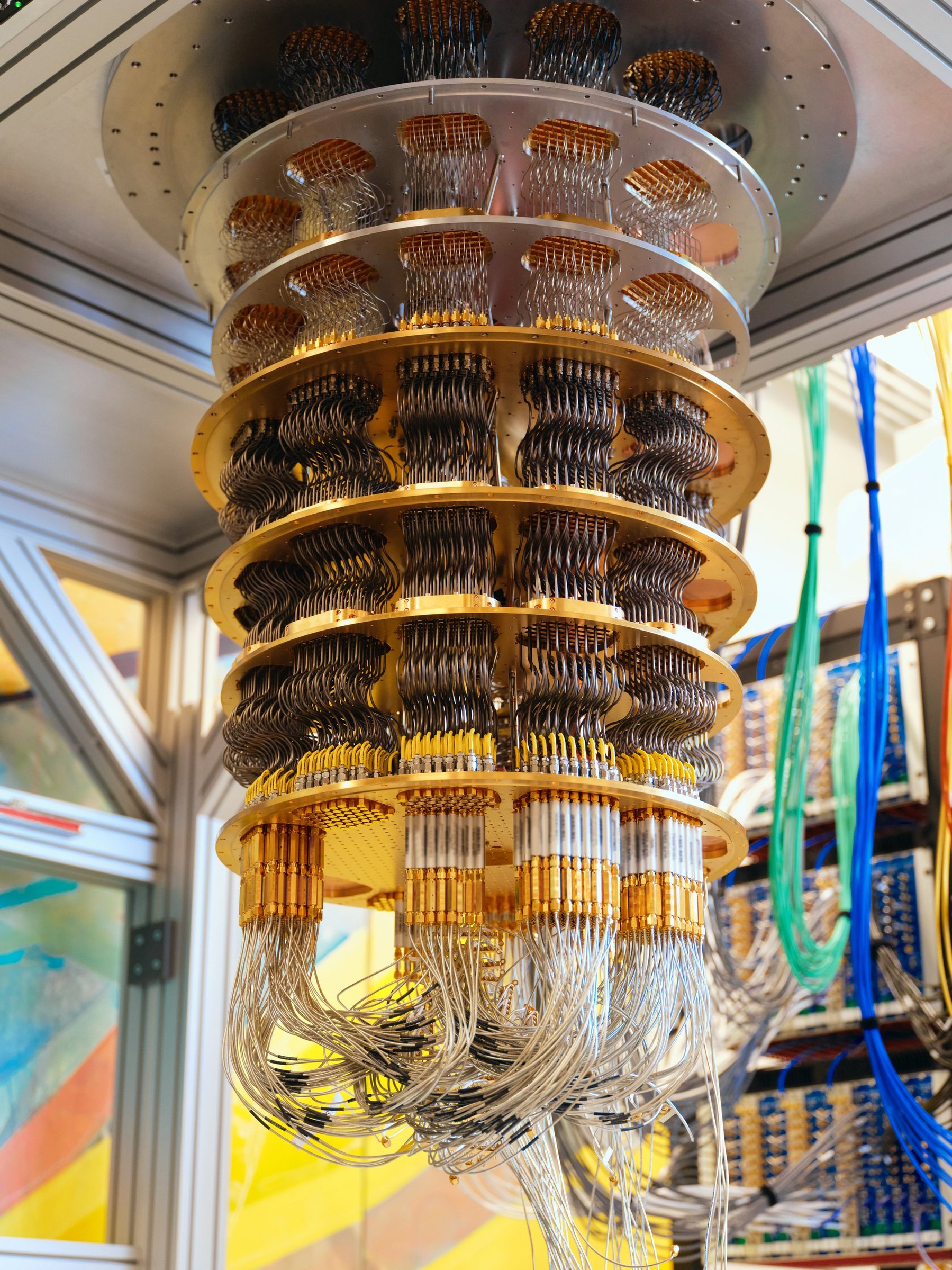
Exploring the Intersection of Quantum Computing and Computational Complexity
The P vs. NP question has captivated mathematicians and computer scientists for decades. It stands as one of the most profound open problems in theoretical computer science, with implications for cryptography, optimization, artificial intelligence, and beyond. But what happens to this age-old question if universal quantum computers—devices capable of leveraging quantum mechanics for computation—become a reality? Would their development make the P vs. NP problem trivial?
Let’s dive into this fascinating intersection of quantum computing and computational complexity.
What Is the P vs. NP Problem?
At its core, the P vs. NP problem asks:
Can every problem whose solution can be verified in polynomial time also be solved in polynomial time?
If the answer is yes, then P = NP. Otherwise, P ≠ NP. This question defines the boundary between problems that are computationally “easy” (solvable efficiently) and those that are “hard” (seemingly requiring non-polynomial time).
What Role Do Quantum Computers Play?
Quantum computers leverage the principles of quantum mechanics—superposition, entanglement, and interference—to process information differently than classical computers. The hype around quantum computing often stems from its potential to tackle problems that are intractable for classical machines.
However, quantum computers exist within their own theoretical framework. Their computational class, BQP (Bounded-error Quantum Polynomial time), defines the set of problems solvable by quantum computers in polynomial time with high probability. This is separate from the classical classes P and NP.
Would Quantum Computers Solve NP-Complete Problems?
The short answer: not necessarily.
The P vs. NP problem is defined in the context of classical computation. Even if quantum computers can efficiently solve some problems in NP, it does not automatically mean that P = NP in the classical sense.
Quantum computers excel at specific types of problems—most famously, factoring large numbers (e.g., Shor’s algorithm) and searching unstructured data (e.g., Grover’s algorithm). While Grover’s algorithm provides a quadratic speedup for search problems, it’s not enough to bring exponential problems down to polynomial time.
NP-complete problems, such as the traveling salesman problem or Boolean satisfiability, are the hardest problems in NP. Quantum computers are not expected to solve these efficiently in general.
“Quantum Computers Solve Everything Faster”: Not true. Quantum computers provide speedups for specific classes of problems but don’t offer a blanket solution for all computational challenges. “Physical Construction Changes Theoretical Foundations”: The existence of physical quantum computers does not alter the theoretical definitions of P, NP, or BQP. These are abstract classes that define computational limits irrespective of physical realizations.
So, What Would Change?
While universal quantum computers wouldn’t make the P vs. NP problem trivial, they would expand our understanding of computation. They might help us reframe classical complexity questions or discover new algorithms that challenge current assumptions about problem difficulty.
For instance:
Quantum algorithms could redefine what we consider “tractable” for certain NP problems, even if they don’t collapse P and NP.
Insights from quantum computing might inspire novel approaches to classical problems.
Conclusion: The Beauty of Complexity The development of universal quantum computers represents a technological leap, but it doesn’t diminish the elegance and mystery of the P vs. NP problem. Instead, it highlights how interconnected our understanding of computation has become, bridging classical, quantum, and theoretical domains.
As engineers, researchers, and enthusiasts, we have much to explore—rethinking what’s possible while respecting the limits of the unknown.
Let me know your thoughts—do you think quantum computing will redefine computational complexity, or will it coexist as a separate paradigm? Would love to hear your take!
I hope you liked it!
Comments powered by Disqus.